
Quentin Tarantino’s The Hateful Eight is not a traditional Western. The film is an intimate drama filled with mistrust, violence, and moral gray areas, driven almost entirely by dialogue. Here, words are weapons – sometimes more dangerous than guns.
That is precisely why The Hateful Eight remains a film that is frequently quoted to this day. The characters do not speak to explain, but to provoke, manipulate, or survive. Every line reveals something about power, control, and the depths of human nature.
In this article, you’ll find the most important and best quotes from The Hateful Eight. Each quote is categorized, explained, and placed in the context of the plot and the characters—so that it’s not just memorable, but also understood.
- “I bring ’em in alive.” – John Ruth
- “I hate polite people.” – Major Marquis Warren
- “This ain’t no fairy tale.” – Major Marquis Warren
- “You talk a lot for someone who’s about to die.” – John Ruth
- “The problem with a lie is it eventually gets checked.” – Major Marquis Warren
- “Everybody here’s got something to hide.” – Chris Mannix
- “Never turn your back on someone you don’t know.” – O.B. Jackson
- “This isn’t a negotiation. It’s an execution waiting to happen.” – Major Marquis Warren
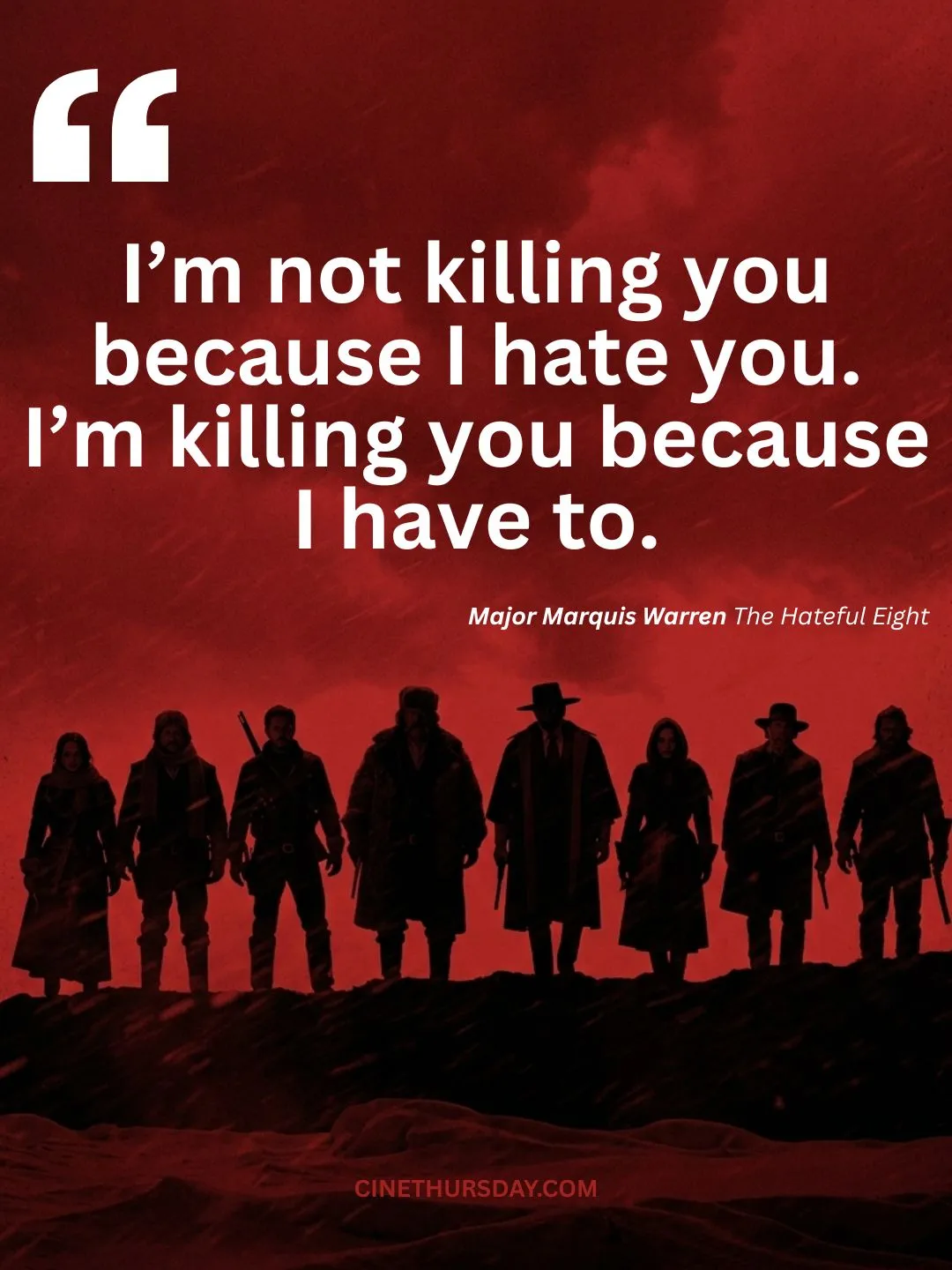
- “I’m not killing you because I hate you. I’m killing you because I have to.” – Major Marquis Warren
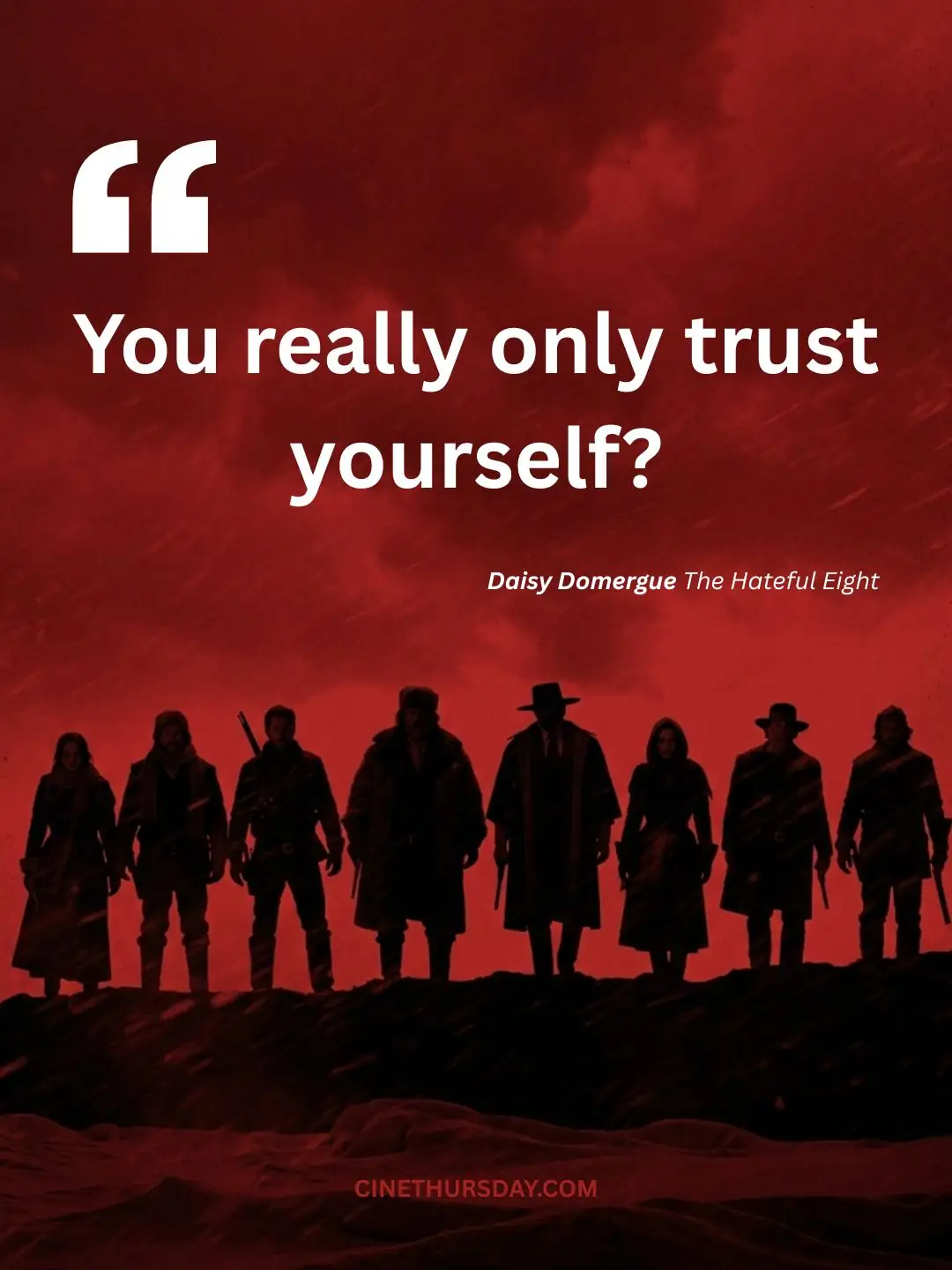
- “You really only trust yourself?” – Daisy Domergue
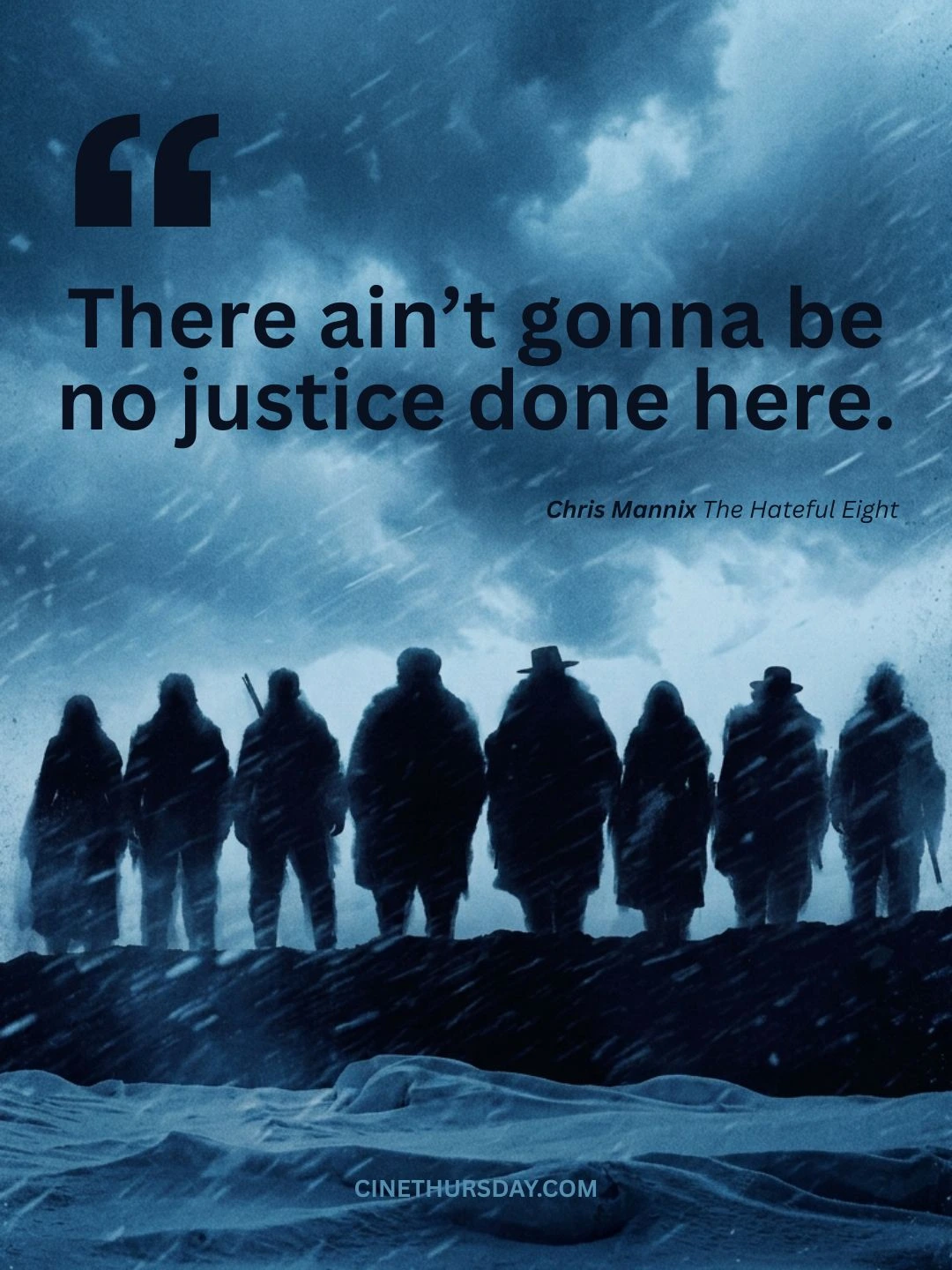
- “There ain’t gonna be no justice done here.” – Chris Mannix
- “Justice is whoever’s left standing.” – Chris Mannix
- Conclusion: Words are the most dangerous weapons in The Hateful Eight
“I bring ’em in alive.” – John Ruth
John Ruth, known as “The Hangman,” defines himself through this quote. For him, delivering criminals alive isn’t just a job – it’s a moral principle. Or so he believes.
The quote reveals a central illusion of the film: the belief in justice. John Ruth considers himself morally superior because he does not kill his prisoners immediately. But Tarantino quickly shows that even this claim is fragile. Ruth’s propensity for violence, his brutality toward Daisy Domergue, and his compulsion to control contradict his self-imposed code of honor.
This quote is emblematic of The Hateful Eight: All the characters believe they are morally in the right – but none of them really are.
“I hate polite people.” – Major Marquis Warren
Major Marquis Warren is one of the film’s most complex characters. With this statement, he makes it clear that he despises pretense and social conventions. For him, politeness is not a sign of decency, but of pretense.
This is particularly important in the context of the film: At Minnie’s Haberdashery, everyone smiles at each other, speaks kindly – and lies. Warren realizes early on that kindness is a disguise in this world. His cynicism is not an end in itself, but a survival mechanism.
The quote sums up Tarantino’s worldview: People who seem too nice usually have something to hide.
“This ain’t no fairy tale.” – Major Marquis Warren
Original: “This ain’t no fairy tale.” – Major Marquis Warren
With this line, Warren shatters any romantic notions about the Western. The Hateful Eight is not a film about heroes, clear-cut distinctions between good and evil, or redemption.
Tarantino deliberately uses the Western genre to deconstruct it. Instead of vast prairies and freedom, there is confinement, snow, and mistrust. This quote is almost a message to the audience: Don’t expect justice; don’t expect a happy ending.
That is precisely why this line is the perfect central quote for the film.
Mehr Tarantino-Filmzitate
“You talk a lot for someone who’s about to die.” – John Ruth
Violence is omnipresent in The Hateful Eight – and it is foreshadowed. This quote illustrates how language becomes a display of power. John Ruth uses words to instill fear, assert dominance, and secure his position.
Typical Tarantino: The threat is almost casual, almost humorous – and that’s exactly why it’s so effective. The viewer knows: When someone says something like that, things are going to get ugly.
This quote is particularly powerful for Pinterest and social media because it’s brutal, direct, and iconic.
“The problem with a lie is it eventually gets checked.” – Major Marquis Warren
Hardly any quote captures the structure of the film better than this one. The Hateful Eight is a film about lies – and about how they are gradually exposed.
Every character plays a role, tells a story, and pretends to be someone they are not. Tarantino constructs the film like a puzzle in which every lie eventually has consequences. This quote serves as a promise to the audience: The truth will come out – but it won’t save anyone.
“Everybody here’s got something to hide.” – Chris Mannix
Chris Mannix is a character full of contradictions: racist, cowardly, yet surprisingly honest in his assessment of the situation. With this line, he sums up the film’s paranoia.
Minnie’s Haberdashery becomes a microcosm of mistrust. No one is innocent; no one tells the whole truth. The quote therefore serves not only as an observation but also as a warning – for the characters as well as for the audience.
“Never turn your back on someone you don’t know.” – O.B. Jackson
At first glance, this quote seems unremarkable, but it is a classic example of Tarantino’s foreshadowing. In a film where trust can be deadly, this line is almost a rule for survival.
It is precisely supporting characters like O.B. Jackson who reveal important truths in The Hateful Eight – even if they are often heard too late. That is what makes this quote particularly tragic.
“This isn’t a negotiation. It’s an execution waiting to happen.” – Major Marquis Warren
With this sentence, it finally becomes clear that there is no way out. The violence can no longer be stopped; it can only be delayed.
Here, Tarantino uses dialogue to build tension without immediately resorting to action. Words take the place of bullets – at least for a moment. This line marks the transition from a psychological standoff to open conflict.
“I’m not killing you because I hate you. I’m killing you because I have to.” – Major Marquis Warren
This quote is disturbingly rational. It illustrates how morality works in The Hateful Eight: not emotionally, but pragmatically. Killing becomes a logical consequence, not an act of passion.
That is precisely what makes the film so unsettling. Violence is no longer an expression of anger, but of calculation. Tarantino forces the viewer to ask whether this is the more honest form of violence.
“You really only trust yourself?” – Daisy Domergue
Daisy Domergue is one of the most fascinating characters in the film. With seemingly innocuous questions like this one, she exposes the weaknesses of others.
This quote reveals her manipulative intelligence. Daisy knows that mistrust leads to isolation – and isolation makes one vulnerable. Even though she is bound, she remains one of the most dangerous figures in the room.
“There ain’t gonna be no justice done here.” – Chris Mannix
Here, Tarantino’s nihilistic worldview is laid bare. It’s not about justice, nor about law and order – it’s simply about who’s still alive in the end.
This quote is perfect as a thematic key phrase because it destroys any hope of moral clarity.
“Justice is whoever’s left standing.” – Chris Mannix
The perfect closing quote. It sums up The Hateful Eight in a single sentence. Justice is not a principle, but the result of violence.
Tarantino makes it brutally clear here: history is written by the survivors – not by the righteous.
Weitere Filmzitate von Quentin Tarantino
Conclusion: Words are the most dangerous weapons in The Hateful Eight
The Hateful Eight is a film in which dialogue kills before bullets do. The lines are not only memorable but essential to understanding the characters and the themes.
Anyone who references this film is also invoking mistrust, violence, and moral decay.
Veröffentlicht am
